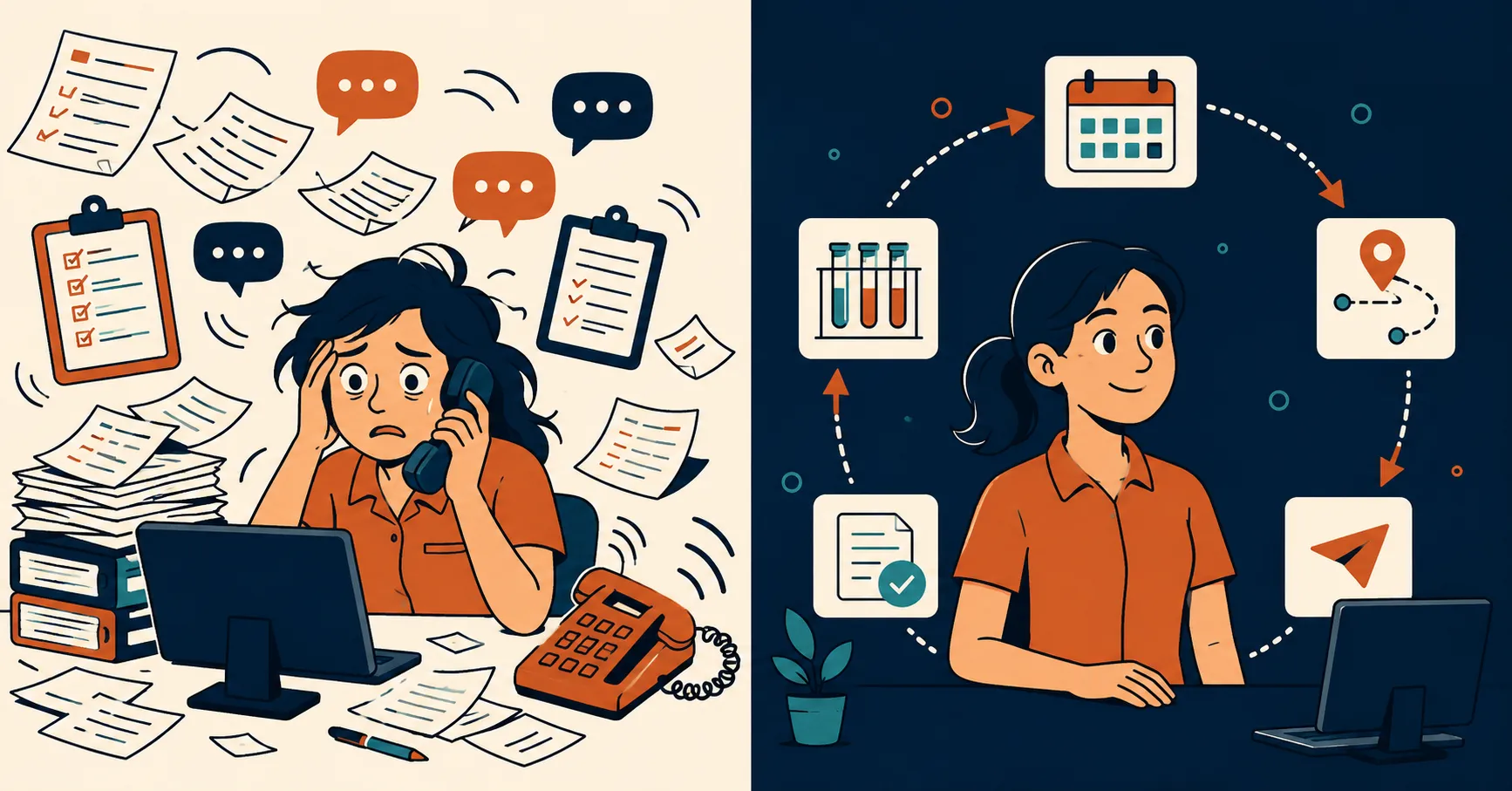
9:02 am: three WhatsApp messages asking for reports that went out yesterday. 9:04 am: phone rings — home collection patient wants to know when the phlebotomist arrives. 9:06 am: walk-in at the desk, form not filled, Aadhaar not ready. 9:08 am: TPA query from last week, still unresolved. Your one front-desk person is already four places at once.
What got missed: TAT log not updated. NABL documentation for the morning batch sat unsigned until afternoon. Two report dispatch calls didn't happen. Home collection routed wrong because scheduling was on paper and nobody checked before the phlebotomist left.
This isn't a bad day. This is Tuesday.
The Admin Load Doesn't Shrink Because Your Lab Is Small
Here's what nobody tells you. Compliance documentation, sample tracking, result coordination, TPA reconciliation — these are fixed categories. Regulation sets them. Care standards set them. Your patient volume doesn't.
A large lab has an admin layer to absorb that load. A billing team. A coordinator. Someone whose only job is NABL paperwork. You have the same mandatory categories and one overworked person covering all of it between walk-ins. The per-person admin burden in a small diagnostic lab is structurally higher — not because small labs are disorganized, but because the workload has a floor that doesn't move regardless of how many patients you see.
Automation pays off most where staff have the least slack to absorb manual work. That's you.
When Your Front Desk Is Running on Memory and WhatsApp
Patient registration on a paper form. Home collection scheduling in a WhatsApp thread. Phlebotomist routing by phone call. Report dispatch manual — PDFs sent one by one. TPA claims on a spreadsheet someone updates when they remember.
Every one of those is a handoff. Every handoff is a potential drop. In a small lab, there's no buffer when something drops. The patient calls back angry. The sample gets delayed. The LIMS entry happens late. The documentation gap shows up in your next audit.
The cost is invisible until it isn't — and by then it's a complaint, a missed claim, or a burned-out person handing in their notice.
The spreadsheet your team pretends is a scheduling tool isn't free. Someone maintains it. Someone checks it. When that person is also answering the phone, the spreadsheet is one distraction away from being wrong. And that distraction comes before they've finished their chai.
Automation doesn't need volume to justify itself. It needs friction. Friction is what your team is drowning in.
What Changes When the System Carries the Load
Tofabza builds workflow automation for diagnostic labs running too few people across too many jobs.
Patient registration automated. Home collection scheduling confirmed without a call. Phlebotomist routing handled by the system, not recalled from memory. Report dispatch triggered the moment results are ready. TAT alerts built in. NABL documentation captured at the point of action — not reconstructed at the end of the day from whatever notes survived the morning rush.
The front desk still exists. They just stop being the connective tissue holding everything together through sheer effort.
Admin cost per patient often comes down because less time is spent coordinating routine work manually. Documentation is captured as work happens instead of being reconstructed later, reducing the risk of gaps during audits. And when staff spend less of the day chasing paperwork, phone calls and follow-ups, the job becomes far more sustainable, making burnout and turnover less likely.
This isn't about becoming a tech company. It's about stopping the coordination failures that bleed you daily — in errors, rework, staff turnover, and audit risk — before the cost lands somewhere you can't absorb it.
FAQs
Why is administration harder for a small diagnostic lab than a large one?
Many administrative tasks—such as patient registration, sample tracking, NABL documentation, report dispatch and TPA coordination—exist regardless of lab size. In a small lab, the same work is often handled by one or two people instead of dedicated teams, increasing the workload per employee.
Will automation replace my front desk staff?
No. The goal is to remove repetitive coordination work, not people. Staff spend less time chasing paperwork, answering routine status calls and manually updating records, giving them more time to focus on patients and exceptions that need human attention.
Can automation work with our existing LIMS?
In many cases, yes. Workflow automation can often integrate with an existing LIMS rather than replacing it. The right approach depends on how your current systems and processes are set up.
How do I know if my lab is ready for automation?
If your team relies on paper forms, WhatsApp messages, spreadsheets or repeated phone calls to keep daily operations moving, you're likely dealing with operational friction that can be reduced through automation.
If you're running a diagnostic lab on WhatsApp, paper forms and spreadsheets and want to see exactly what a system built for your operation looks like, reach out to Tofabza. No pitch. Just a look at where the friction is and what it's actually costing you.